Monday, May 29, 2017

Music Replacement at Ridgemont High

FAST TIMES AT RIDGEMONT HIGH holds dear to so many Americans as a portrait of high school in the 1980s in the US, not necessarily on a scholastic level, but on a social level. Following a group of students over a year of high school, piggybacking on the shoulders of films like Grease a few years before, FAST TIMES has endured its status as a cult classic on VHS and Cable TV. The television version added many scenes to the film which according to the film's screenwriter and director are now lost due to a purging of the Universal Studios vaults of all deleted scene material in the 1990s. In addition to this change, however, came a modification of the film soundtrack.

Popular music in film and TV shows can be costly. Those who work in the industry know that shows such as The Wonder Years, WKRP in Cincinatti or Happy Days on DVD or Netflix need these alterations or the cost to release a film on home video, TV, or streaming would be very expensive. In the 1980s, the same game was being played for VHS releasing. Universal Pictures rescored parts of films such as SIXTEEN CANDLES, WEIRD SCIENCE, and our example here: FAST TIMES AT RIDGEMONT HIGH. In 1987 and 1990, the home video releases had made the following changes to the film, comparing runtimes to the 2004 DVD which reinstated all of the original music:

00:07:15-00:08:52: Tom Petty's "American Girl" has been replaced with generic music in the first scene that features Ridgemont High School.


00:25:47-00:26:40: The Christmas montage leading into Stacy and Linda discussing how Stacy's been dumped by Ron replaces Darlene Love's "Winter Wonderland" with a Christmas song my Shazam wouldn't recognize that starts "There was a bit of mistletoe, and a field of falling snow, on this little Christmas time......". If anyone knows it, please comment on what it is......


00:44:08-00:45:36: As Spicolli and Jefferson's brother are driving around recklessly, Sammy Hagar's "Fast Times at Ridgemont High" with generic rock music. Yes....infuriatingly, the title song to the film has been replaced with generic music. This replacement music with the dialogue is sampled at the beginning of the song "Dalyla" by the Phunk Junkeez, which can be heard here.


00:46:18-00:46:52: In the very next scene, as students are walking through the halls preparing for the Ridgemont vs. Lincoln game, Donna Summer's "Highway Runner" has been replaced with a generic rock music cue.


00:47:45-00:49:43: During the football game, "Fast Times (The Best Years Of Our Lives)" by Billy Squier has been removed and replaced with an unknown song.


00:50:07-00:50:33: As Stacy and Linda are sunbathing, the song "Don't Be Lonely" by Quarterflash, playing on the portable radio, has been replaced with a generic song, now with male vocals as opposed to the female vocals of the Quarterflash song.


00:51:06-00:53:09: When Mark and Damone come by uninvited and start horse-playing in the pool, followed by Brad coming in and telling them to keep it down, leading up to brad spying on Lynda, Don Felder's Never Surrender has been replaced with an unknown song that sounds similar to it.


01:27:03-01:27:44: After Stacy and Linda discuss how Stacy wants romance more than sex, when Stacy spots Mark across the way at the movie, the Timothy B. Schmidt remake of "So Much In Love" has been replaced with an unknown love song similar in theme.


01:30:49-01:36:48: The text epilogue of all the characters followed by the end credits replaces Oingo Boingo's "Goodbye, Goodbye" with a similar sounding unknown song.


There you have it, all the changes made to the initial 1987 and 1990 home video releases of FAST TIMES AT RIDGEMONT HIGH. The end credits for the home video have been altered to remove the songs that were taken out for home video, but the replacement songs are all uncredited. In addition, the titles are reformatted toward the end so that they finish when the song finishes. 1996 would mark a new home video release of the film that, according to IMDB, reinstated all of the original music except for Tom Petty, Timothy B. Schmidt, and Oingo Boingo. The film's soundtrack does make the picture, however, and having the original soundtrack reinstated for the DVD gives the viewer the full experience of the film that had been missing for many years. Interestingly enough, director Amy Heckerling didn't care for the original soundtrack of the film. In the DVD commentary, she is constantly criticizing it, saying that the country-rock songs of Jackson Browne, etc., were originally put in by studio execs, but she wanted more of a new wave and punk soundtrack, more representative of teens of that time but that the studio felt would alienate other viewers. Who knows, maybe Heckerling would have preferred the replacement VHS music?

Friday, April 28, 2017

I Watched the Cosby Show This Year and I Am Proud to Admit It

A few months ago, on a Saturday evening, my partner and I were at home thumbing through the DVDs and I threw on a disc of The Cosby Show. That evening, we laughed and smiled nostalgically at the many memories the show has given us. I had forgotten how funny it was! The amazing 80's fashion was a hoot, the writing was as fresh as the first time I saw it, and Lisa Bonet was as gorgeous as ever. More importantly though, as a person who has always been a huge fan of The Cosby Show, I was glad that I was finally able to revisit it without hesitation once we got into the first episode of the disc. The world did not end, I didn't feel ashamed for enjoying myself, and I didn't feel as though I was betraying the plantiffs of the several cases that were attempted or are now ongoing against Mr. Cosby.

I am not writing this article to troll the internet. In no way do I want to minimize what happened to the victims. When the first allegations appeared in 2007 I did not want to believe them. I would find it very difficult to believe anyone who asserts that Mr. Cosby is innocent after the many, many stories of abuse and rape that have appeared in the last few years. The reason I write this is because I refuse to let my memories of my favorite sitcom, one that I believe is still a great piece of television, to be destroyed by the selfish reprehensible actions of an individual. My relationship with The Cosby Show, as a classic piece of pop art, is too intertwined with my individuality for me to allow that to happen.

Growing up, I was of that age where I missed the window of time in which The Cosby Show had in syndication on network affiliates. We didn't have cable growing up at my parents' place because my parents were afraid that it would rot my brain and turn me into a couch potato. I faintly remember the show running in the 3pm-5pm hour when I was 6, but after that, I didn't see the show for almost a decade. When we moved to the other side of town, and the only way we could get television was if we subscribed to cable, the show popped up on WGN and TBS. I immediately fell in love, catching every episode I could. I loved all of the special guest stars that appeared on the show. I loved that I was exposed to a culture of music and art that one can't get in the very Euro-centric education system we have in the United States. I loved how much in love the main characters, Cliff and Clair, were. Looking now at when that show came out and comparing it to other popular shows that were on the air at the time, such as Diff'rent Strokes or Gimme a Break!, The Cosby Show had an edge to it that many sitcoms at the time lacked. This is the reason that up until recently, it still was regularly being shown in syndication, whereas the others were long forgotten.

In college, I finally went all out and rented the entire series on DVD. During the period of time when the entire series was uploaded to Youtube, I used to play Spider Solitaire and half watch the shows to wind down before bedtime. The show became a favorite of mine and I wore it out, to a point where I knew every episode by heart and I eventually became sick of it from watching it so much, as does happen with favorite films and shows.

Time passed. Then the allegations came. Then more. Then evidence. Then debates about the allegations. Then came the documentary about the allegations. As people tried defending the show without defending the man, it seemed that they were being criticized, and I still am not certain as to why. I was really sad to see my TV dad take the heat for the actions of the actor who created and played him. The show, as a piece of art, does focus on a fictional character that Cosby based on himself, off as it may have been from the truth if the allegations are true (which I believe they are), but the show is still a work of fiction.

I was timid for a long time to revisit the show. But, as does happen when one has a favorite show or film, moments would pass in and out of my head that would make me think about how much I had missed watching it. I was getting an itch to watch it again, but didn't know if acting on my itch would make me a bad person. Then it dawned on me: I'm not a bad person-- that man is, and why should I let that ass-hat ruin my experience of enjoying a show I really wanted to see again?

In addition, let's take a quick peak at the amount of people who have created warm fuzzy media memories and are still cultural icons when remembered for their art but in person had some troublesome controversies: Frank Capra was a known racist who hated Black people. No one has ever boycotted his films from the widespread re-releasing they have gotten over the last 80 years. Woody Allen's new film was well received and his films are still being run and taught in film classes as classic cinema DESPITE the fact that his stepdaughter Dylan Farrow made very bold statements against him as of recent, alleging that he molested her when she was 13. Roman Polanski, whose alleged assault on a 13 year old child kept him from returning to the United States for 30 years, is still considered a great filmmaker, with Chinatown and Rosemary's Baby constantly being shared with new generations.

I don't say the heinous actions of these individuals gives us the right to glance over what Mr. Cosby has been accused of, but the question must be asked: Why are we holding him to a different standard than these other artists when it comes to separating the art from the artist? Is it possible that the show will one day come back into circulation? Mr. Cosby has an alleged fortune of $350 million. It is doubtful cutting him off from syndication residuals would break him. Or is this the time society will finally hold true to a punishment against a celebrity who has misbehaved and not let the show back into the world of reruns?

Sunday, March 26, 2017

Why Judy Garland is Amazing

So much has been written about Judy Garland, and it is unfortunate many seem to focus on her failures rather than her success. When people talk about Judy Garland being famous, too many stories portray her as "the girl from THE WIZARD OF OZ who became an addict and died of an overdose". There is much more to this wonderful performer beyond her rich singing pipes and drug addiction than people give her credit for. Appearing in 41 films (34 of which were between 1930 and 1950), Garland had a strenuous acting career, the whole time running on little sleep due to her parallel career as a recording artist, involving cutting records, regularly performing on radio programs, and going across the country on concert tours.

There was a certain *spark* in Judy Garland that few performers today can hold a torch to. Here's why:

1) Acting ability

At a time when many actors simply followed a direction as told, there were many moments in Judy's career where Garland has these very "natural" method acting moments that sometimes get overlooked. Take for example this moment in THE WIZARD OF OZ while Garland sings Over the Rainbow. The dog playing Toto raises his little paw, probably unscripted, and instead of freezing like a deer in headlights, Garland simply keeps going with the song, grabbing Toto's paw and squeezing it.


via GIPHY

Another great moment is in MEET ME IN ST. LOUIS. While their father plays the piano and the family eats their cake and ice cream, Margaret O'Brien grabs at Garland's cake. Notice how Garland very naturally moves her sister's hand, cuts off a bite of cake, feeds it to her, and then cuts off a bite for herself. Another great underplayed moment by this great actress.


via GIPHY

2) Storytelling

Whether it was discussing Marlene Dietrich's record of applause, losing an Academy Award win while in the hospital, or performing with a professional vomiter in her vaudeville days, no one could tell a story like Judy Garland. She refers to many nouns with the adjective phrase 'great, big', as in: "It was a great, big record" or "Three great, big men" or "We were in a great, big car". Her stories started coming about during her concert years while her band would change up the music, as heard on her live records from Carnegie Hall or the Cocoanut Grove, but can also be seen in her appearances on talk shows such as Johnny Carson and Jack Paar as well as her television series.


via GIPHY

3) Her Laugh

Judy had an infectious laugh, booming loud and high that is hardly heard in her films. The studio never allowed her characters to display the hearty laugh she possessed, and today it is usually only through outtakes and self appearances on talk shows and her own television show that one really gets to hear it. A classic audio outtake of her in "A Star is Born" is popular among fans, in which she lets loose during the recording of "Swanee".


via GIPHY

4) A Child Is Waiting

Judy Garland challenged her abilities as an actor taking on this 1960's film directed be John Cassavetes about a school for developmental disabled children, at a time when education of such children was still limited. Cassavetes was known for encouraging actors to underplay their parts, even improvise, and Garland is thrown into a group of highly ranked dramatic actors, such as Gena Rowlands and Burt Lancaster, and manages to hold her own in a role that is very subdued, when she could have done it much more dramatically. On top of this, many of the children in the film were portrayed by child actors diagnosed with disabilities such as Down syndrome and autism, and Garland blends in so well that at times one feels as though he or she is watching a documentary about the school and forgets it is Garland in a performance. Her end scene as she coaxes a frightened child out of a car into the school is most memorable.


via GIPHY

5) Get Happy

An iconic image of Garland-- her in this beautiful man's suit where the overcoat is hemmed to be a skirt and she wears pantyhose instead of pants. A costume that was designed for Garland in Easter Parade for a number called "Mister Monotony" which was cut for its risque material, MGM's costume department attempted to reuse it for this number in what would be Garland's last film for the studio. A sexy look from an actress that was once known for her 'girl next door' image, this music number from Summer Stock will live on as a classic moment in cinema history.


via GIPHY

Saturday, March 4, 2017

The PORKY'S Problem -- NSFW

So here's a question: how can the simple altering of a film's aspect ratio change its rating from an "R" to what should be classified as an "X" (or an "NC-17" today)? Such is the case with the 1981 cinema classic PORKY'S.


But before discussing this coming of age gem, it is imperative the reader gets a quick "Widescreen 101" lesson. Making a film widescreen can be done many ways but here are the most common three.

The most common piece of 35mm film is a square format. Anamorphic widescreen is squeezing a wider image onto a piece of square film using a magic camera lens, like this:


and then stretching it back out onto the screen using a projection lens that un-distorts it, as seen below with this Sound of Music example:


This was the original engineering of Cinemascope and today is most common with films shot in the wider 2.39:1 aspect ratio.

Another way of doing this is to shoot the film onto a square image with hard mattes inside of the lens. This way, when the film is shot, it comes onto the film in its widescreen ratio with black at the top and bottom of the image.


When it is projected onto the screen, the projectionist focuses the image to make sure the black at the top and bottom of the image does not come onto the screen and the image appears widescreen, as seen here:


Then comes the story of open matte filming and our film PORKY'S. Open matte filming is shooting a film in a square aspect ratio and knowing as a cinematographer that the top and bottom portion of the frame is going to be cut off by the projectionist when it hits the screen as only what can fit onto the widescreen is going to make it onto the screen of the theater. For example, by looking at the CBS/FOX laserdisc, here is what the camera captured of this frame of the film in the opening sequence of PORKY'S:

\

The red lines on the following image signify where the film gate would have cut off information above and below the projection screen:


And from the DVD screenshot below, you can see what that final image would have looked like on the projection screen:

''

Open matte filming was common in the days of film, and has its pros when it came to home video release. Because most VHS (and a number of laserdisc) releases in the United States were fullscreen to fit the square shape of TVs at the time, this meant if a studio shot a film open matte, as was the case with films like PORKY'S the film did not have to be cropped from its widescreen ratio (commonly referred to as "pan and scan") for home video release. However, the cons were if there was unnecessary artifacts that appeared in the frame, such as a boom mike, they would appear in the open matte home video release.

And then there is the magical case that is PORKY'S. A 1981 raunchy teen sex comedy, now available on DVD from FOX Home Video, PORKY'S was filmed open matte in such a way that in several shots its projection in a movie theater would cut off the male genitalia from the film gate right at the pubic region, bordering it from being an R-rated and X-rated in a few instances. Today, a glimpse of man-meat in an R-rated film is not uncommon. Films like FORGETTING SARAH MARSHALL have now freely displayed up to 10 seconds of penis on screen, and the MPAA will allow it depending on their mood that day. In 1981, though, the rules were a little stricter, and seeing more than a flash of male genitals on screen in a theater would mark the film with an X rating immediately. PORKY'S pushed the envelope by revealing more of what was considered acceptable for male nudity in an R-rated film, but followed the MPAA rule for many shots when it is shown in its intended aspect ratio, matting the top and bottom of the image. Compare these shots from, first, the FOX DVD and then the CBS/FOX laserdisc, keeping in mind that until the film was released on DVD, this is how people saw the film on home video:


Clearly, more has been revealed. While PORKY'S does contain some male nudity in the "Cherry Forever" scene, revealed both on the matted DVD and on the open matte VHS and laserdisc, pushing the boundaries of its time, if you really want to see more revealed, check out the out-of-print VHS and laserdiscs. As a side note, by looking at the nudity that's both on the matted and open matte home video releases, it appears that the character "Meat" was given a nickname he may not have deserved.....

Monday, February 13, 2017

The Ten Commandments: Telecast vs. Theatrical Version

Behold the mighty telecast! Since 1973, ABC has run The Ten Commandments (1956) annually (with the exception of 1999), around the Easter and Passover holiday, making it a staple in American television. Isn't it amusing that while other films that were historically broadcast annually, such as The Wizard of Oz (1939), have been retired from network TV telecasts, and the habit of running films on network TV as a whole has come to a screeching halt, that this is one of the few films that still gets run, nearly uncut in a single evening block, and successfully pulls in Nielson ratings after 40 years.

That isn't to say that this film is untouched, however. For years, The Ten Commandments came from a special print that was edited for television and then transferred to 1" videotape, and the edits, while minor, are noticeable to the naked eye.

The most obvious editing, for the sake of commercials, happens on long shots that lead to commercial break. The Ten Commandments is notorious for having a long shot that focuses on something like a piece of the cloth Moses is wearing, or Ramses face in anger, before fading into the next scene. Because the original VistaVision dissolves are quite long, the film print used for the telecast fades to black early in the shot, making it half as long. These edits are not included in this essay.

Speaking of film, the edits are done on the film print used for the broadcast, as opposed to editing on the video (as was done with The Sound of Music). This is clear from the fact that when an edit is made, the audio delay of the edit (sound is eight frames ahead of the frame), is present. For example, when the telecast cuts a baby stabbed on screen, the dialogue from the last scene is heard after the cut is made. This would not have happened if the edit was done on the videotape.

The comparison seen here was taken from the 1982 telecast, which was the same version run from the 1970s and into the 1990s. As newer broadcast formats and high definition TV became more prominent, however, new transfers of the film came out, meaning new edits. Still, as is apparent here, the film is left practically untouched content wise.

Starting from the beginning of the telecast, this is what was edited out of the original film for the telecast:

00:00:00-00:01:36 : The overture has been removed from the telecast.


00:01:36-00:03:55: The famous prologue by Cecil B. Demile explaining where he researched the story of Moses for the script of the film has been replaced with a text scroll that last about 10 seconds, seen in the second and third screenshots below.


00:08:30-00:08:35: Telecast puts an "Edited for Television" caption over the first shot of the sky.


00:10:45-00:10:50 After the pharaoh says "So let it be written, so let it be done," and his adviser says "So speaks Ramesis the first!", the shot of a Roman stabbing a baby is removed, with a hard cut into the scene, as opposed to the original fade.

00:31:18-00:31:21: A shot of Yoshebel being crushed by the stone while Moses builds his city is removed.


00:31:27-00:31:29: Another shot of Yoshebel being crushed by the stone is removed.


00:31:35-00:31:39: A shot of the stone closing in on Yoshebel is removed.


00:42:37-00:42:52: As Rameses and Nefretiri discuss their relationship, and Rameses says "You will be my wife," the telecast cuts him saying "You will come to me whenever I call you, and I will enjoy that very much. Whether you enjoy it or not is your own affair...but I think you will."


01:12:20-01:12:22: As the old man in the mud pit confronts the soldier about the way women are objectified by the pharaoh's men, after the soldier says "This will change your image", the soldier throwing the knife into the man has been spliced out of the telecast, going directly to him falling into the mud.

''

02:15:28-02:15:38: Intermission card is removed from telecast.


DISC 2:

00:00:00-00:02:13: Telecast omits entr'acte and begins second half of film after a commercial break.


01:30:38-01:35:43: Exit music is not present in telecast.


What is most interesting is that while there are content edits made, they are all done in the first half of the telecast. This isn't to say that the second half is less violent or sexually suggestive than the first half, but because a whole evening of programming was blocked out, it could be that the network felt the later part of the evening could show more explicit material. For example, Pharoah's men drowning in the sea is not edited in the telecast, but Yoshebel being crushed by the stone is heavily edited.

The film is practically left untouched, interestingly enough, and although it's been 40 years, the network still pulls in enough steady ratings for the film to be shown annually. Still, nothing can capture the magic of the film being shown on a big screen in its VistaVision Technicolor glory.

Sunday, January 22, 2017

The Sound of Music Annual Telecast

How do you compress a 3 hour film into a 4 hour time slot and make room for commercials? By completely reediting it. The Sound of Music (1965) has an annual telecast every year, starting in 1976 on NBC. The film was pan and scanned for the first time and starting in 1978, chopped by about 35 minutes, before being mastered to videotape and then being run every Christmas. For almost 20 years, this was the version shown annually. Because of the expensive retail videotape (although available for rental) and the film rarely being seen in theaters, this was a version many people were familiar with. The following is a side-by-side comparison with the 1984 Christmas Day broadcast. The timecodes listed on the 20th Century Fox 5-Star DVD release from 2000 (now out of print).

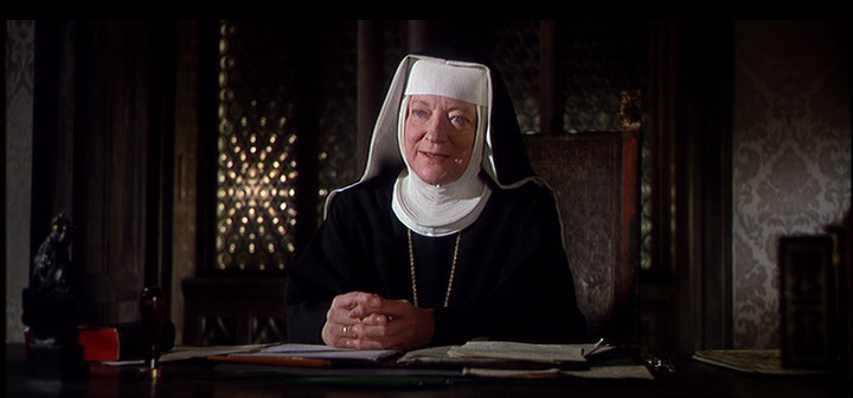
00:09:00-00:09:50: In the scene following the opening titles, as the nuns are singing during mass, the "Allelujah" portion of the song has been cut. The first line can be heard and then fades out as the image cuts to Sister Bernice running to the Reverend Mother.


00:14:51-00:15:10: After the song "Maria" but before Maria and the Reverend Mother meet about Maria being sent away from the abbey, footage of Maria waiting in the hall to speak with the Reverend Mother has been deleted, as well as one of the sisters coming out and telling her she can go into her office. The telecast fades to after Maria has entered the office and the Reverend Mother says "Come here my child".


00:15:51-00:16:40: As part of Maria and the Reverend Mother's conversation, after Maria says she was brought to the convent by looking over the convent's garden, a section is cut as she goes into detail about remembering the nuns singing on their way to vespers. She then admits that she has a problem singing all the time and saying everything she thinks and feels. The Rev. Mother consoles her, saying this is a good quality to have. They debate whether or not the convent is the best place for her. The telecast cuts to Rev. Mother telling Maria it is the will of God that she leaves.


00:17:42-00:18:25: Maria asking the Rev. Mother why it's difficult for the captain to keep a governess and her response, as well as the shot of Maria leaving the abbey leading to "I have Confidence" have been cut. The telecast fades from the Rev. Mother to Maria saying "When the Lord closes the door, some way he opens a window."


00:19:36-00:19:59: A portion of "I Have Confidence" has been cut. It goes straight from "Then why am I so scared?" to "I am seeking the courage I lack."


00:22:26-00:23:06: After Maria says "Oh, help!" in "I Have Confidence", the last chorus where she runs through the gate is cut. The telecast fades to commercial and fades back in as she catches her breath after ringing the doorbell.


00:25:27-00:25:38 After the captain asks to inspect Maria as a governess and says "It's the dress..." there is a deletion of dialogue between the two of them about how she had given the rest of her belongings to the poor but they didn't want the dress she was wearing, cutting to "I would have made another dress but there wasn't time."


00:28:42-00:28:57: After the captain introduces the children to Maria with their whistles, a portion is missing when he asks her to repeat them back to see if she's learned them. She states that she won't need to because she wants to learn their names, and he expresses discontent as the grounds are large. It cuts to him giving her the whistle.


00:34:59-00:35:01: During the dinner scene, after Maria covers up for the children playing a prank on them, and Marta begins crying, the section where the captain asks her what is wrong and she says "nothing" has been deleted.


00:36:25-00:37:06: After Liesl asks the captain if she can be excused, the telecast cuts the rest of the scene where the captain says he is going to Vienna and the children scowl in protest, and after inquiring find he is going to visit Baroness Schroeder and bringing her back with Uncle Max, which excites the children.


00:38:04-00:38:41: When Rolfe and Liesl meet in the Gazebo, when Liesl delivers her verbal "telegram" to Rolfe, their discussion about the captain's political stance and how Rolfe is worried about her more than him is cut, going directly from "Dear Rolfe, stop" to "Why, you're such a baby" and into "Sixteen Going on Seventeen".


00:44:33-00:45:04: When Frau Schmidt drops off the material for Maria to make dresses and she shows herself out, dialogue of Maria asking a second time about material for clothes for the children and Frau Schmidt confiding in her that the captain will be gone for a long time and is rumored to marry the baroness has been cut, going from her saying "Goodnight now" to Maria saying "Goodnight".


00:51:55-00:52:11 :After "My Favorite Things", when the captain barges into the room angrily, his interrogation of Liesl going missing after dinner, as well as Maria's fib that they were getting to know each other in her room has been removed, cutting to Maria demanding the children go back to bed.


00:54:48-00:55:21: During the children's tour through Salzburg, the section in the market place where Maria juggles tomatoes, Greta drops one, and Maria stops her from crying is cut.


00:55:57-00:56:17: In the picnic scene, preceeding "Do-Re-Mi", after Brigitta asks Maria if they can have a picnic every day, their exchange about how she might get tired of it and of different pranks they've played on the other governesses has been removed, going directly from Brigitta's question to Maria saying, "Well, we'll have to think about that one."


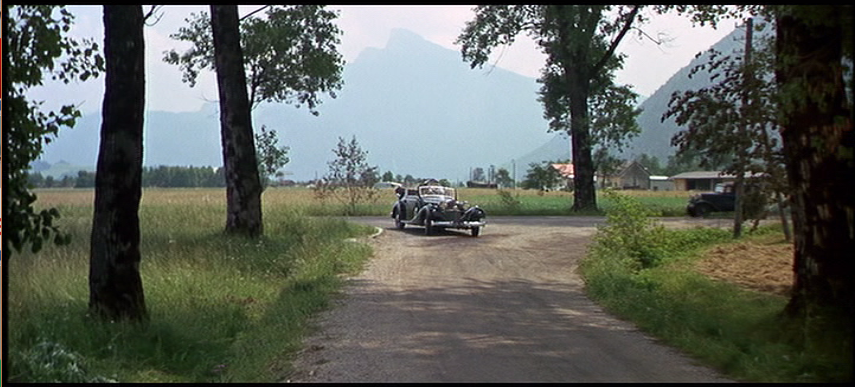
01:02:38-01:02:52: Following "Do-Re-Mi", the extended shot of the car before it cuts to the captain, baroness, and Max discussing the mountains has been removed.


01:02:58-01:03:34: After the baroness tells the captain the mountains are magnificent, the entire conversation about Max inviting himself along as the baroness' chaperone and expressing an interest in being a sponge of the captain's hospitality is deleted, cutting to him intrigued about the music of the Clockman monastery choir.


01:06:54-01:07:03: On the patio, the exchange between the servant and Max where she offers him more strudel and he accepts is deleted, starting the scene with the captain directly saying "Still eating Max?"
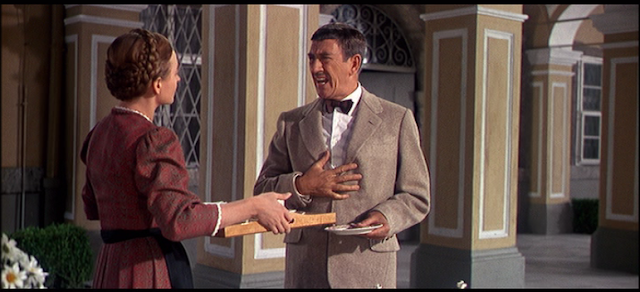


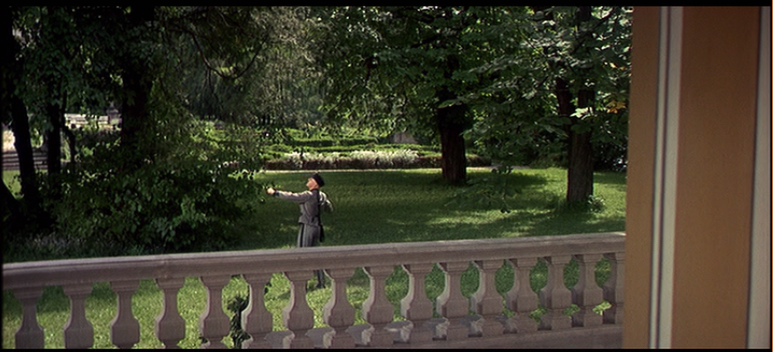
01:08:53-01:09:05: The sequence of Rolfe throwing pebbles at Liesl's window and the captain catching him is shortened, going from the first time he throws a pebble directly to the captain asking "What are you doing there?"


01:16:00-01:16:08: There are three shots of the captain and the children looking at each other after the "Sound of Music" reprise deleted before they embrace.


01:25:15-01:25:51: During "Edelweiss", the section of Liesl singing along with the captain has been removed, cutting to the final coda in the telecast (an awkward sound phasing occurs from the 1" master edit when this happens in the telecast).


01:26:09-01:26:14: The captain and Maria exchanging looks as he shrugs after his performance of "Edelweiss" has been removed.


01:26:20-01:27:01: After Max says the captain can be a part of his new act "The Von Trapp Family Singers", the telecast fades out to commercial, removing the baroness requesting the captain throw a party for her and the children's excitement as Maria takes them to bed, and fades back in at the party.


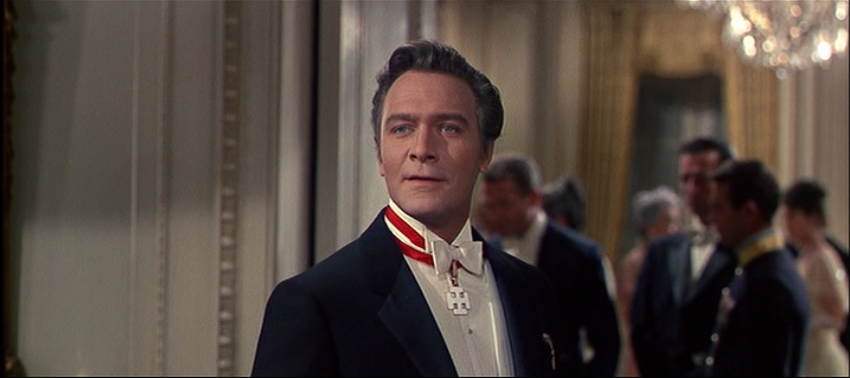
01:27:19-01:27:40: The opening of the party scene has been shortened in the telecast, removing the cars arriving and guests gathering in the main hall.


01:28:22-01:29:03: The children making comments about the couples at the party and Liesl pretending to dance before Frederick asks her to is cut from the telecast-- it goes from the ballroom directly to the two of them dancing together.


01:32:09-01:32:19: After the baroness (catching the captain and Maria dancing) makes a comment about him not being able to find a friend at the party, the captain remarking it's rather chilly and the baroness saying it seems rather warm to her is trimmed before Maria makes an announcement about the children's performance, as well as the opening "Ladies and gentlemen," of her announcement.


01:32:28-01:33:13: The opening of "So Long, Farewell" is cut, opening with the main verse.


01:35:37-01:35:42: A shot of the crowd after the song ends (with the crowd waving) is removed.


01:37:12-01:37:33: After their heated exchange, Herr Dettweiler saying "You flatter me captain," and the captain responding he meant to insult him has been deleted, as well as the opening of the baroness and Maria's conversation, cutting to the baroness asking Maria where a specific outfit is.


01:39:27-01:39:43: More footage of Maria packing after the baroness leaves, as well as the baroness walking through the main hallway is cut from the telecast.


01:40:32-01:40:47: After Max and the baroness discuss how she can influence the captain into having the children sing in his festival, the telecast cuts her walking over to the captain and waltzing with him, going directly to Maria leaving the house with her luggage.


01:41:37-01:43:18: Intermission and Entr'acte are removed from telecast.


01:43:18-01:44:00: The opening of the second act, with the baroness and the children playing their counting ball game is trimmed. While the opening shot of the house is the same, the telecast opens with the audio of Frederick saying "I'm number five," and lasts about 10 seconds before cutting to the actual footage of the scene to match the audio being heard.


01:47:00-01:47:15: After Brigitta asks the captain if it's true Maria is not coming back, the telecast cuts him asking what the drink on the table is and the baroness replying "pink lemonade," and Brigitta pushing the matter about Maria.


01:47:28-01:47:32: The captain claiming he is brave enough to try the lemonade is cut.


01:47:36-01:47:44: The baroness and Max commenting on the lemonade being good but too pink is deleted, as well as Gretl saying "Father?", cutting to her asking who their new governess is going to be.


01:47:46-01:47:50: The shot of the captain, pausing before he answers Gretl, is trimmed.


01:48:47-01:49:06: As the children are one by one kissing the baroness, Kurt's kiss and the captain stopping them and telling them to go away is cut. The telecast also adds the music cue transitioning the two scenes to the children kissing the baroness to make the editing easier.


01:49:42-01:49:50: As the nun greets the children at the gate, she is confused about who Fraulein Maria is, and then as it strikes her who they are asking about she lets them in.


01:49:57-01:50:03: The nun telling them to wait while she speaks to the Rev. Mother is cut.


01:50:34-01:50:46: After another sister, conversing with the children, says Maria is in seclusion, her telling them that she isn't seeing anyone and Frederick and Gretl insisting is cut.


01:51:49-01:52:09: Rev. Mother intaking the new postulant for the convent is cut; the telecast begins with Maria entering the room and the Rev. Mother saying "Yes, bring her in."


01:53:07-01:53:27 : After Maria says "I can't face him again", the Rev. Mother excuses Sister Margaretta before asking if Maria is in love with him.


01:53:39-01:54:16: Maria admitting that she had an attraction to the captain and felt guilt because she was there on God's errand, as well as the Rev. Mother explaining her love for the captain is okay is cut.


01:55:53-01:55:58: As the telecast has to cut back and forth between Maria and the Rev. Mother to get both of their reactions to "Climb Every Mountain", due to the 2.35:1 aspect ratio, the telecast reuses a closeup shot of Maria during this period for continuity purposes.


01:56:28-01:59:40: Following "Climb Every Mountain", the captain questioning the children about where they were and them fibbing and saying they were picking blueberries is cut, fading from the song to Gretl saying "I feel awful".


02:03:54-02:04:31: After Maria says she is only staying until arrangements can be made for another governess, the shot of the captain's reaction is trimmed, as well as Maria walking down the steps of the gazebo that same night fading directly to her by the pond.


02:04:47-02:05:40: The baroness joking that the wiener schnitzel is too delicious for her figure, before the captain breaks up with her and her discussing their wedding plans is removed.


02:06:33-02:06:35: When the Baroness says that somewhere out there is a lady that will never be a nun, the telecast uses the deleted footage from before of Maria at the pond instead of the theatrical version's shot.


02:08:40-02:08:43 -When the captain is trying to get Maria to stay and speaks of his separation, the telecast deletes him saying "Maria...." before he says "There isn't going to be any baroness."

02:23:12-02:23:35:After Max brings the children home to greet Maria and the captain after their honeymoon, and the captain expresses frustration about telling Max how he feels about his children singing in public, Max telling the captain that it's for Austria and that the overtaking was peaceful, and the captain should be greatful for this, to which the captain gets angry. has been deleted The telecast comes back in at "You know Max, sometimes I don't think I know you."


02:27:51-02:28:37: After the captain receives his telegram asking to join the German navy, and Maria said she knew it would happen but didn't expect it so soon, the rest of their conversation about needing to leave has been removed, cutting to the evening scene when the family is pushing the car out of the gate.


02:29:58-02:30:10 :As the family push the car out of the house, footage of them pushing it through the front gates and the servant seeing them is cut.


02:32:34-02:33:05: After the family is caught escaping by Herr Zeller, and Maria says their travel clothes are their costumes for the singing festival that night and that the cold air isn't good for the children's voices, Herr Zeller instructing that the family will sing for the sake of Austrian and German relations has been removed, going directly to him saying his men will escort them to the festival.4


02:33:17-02:33:28: When the captain says an escort won't be necessary, Herr Zeller saying he would not want them for them to get lost in the crowds is deleted.


02:46:21-02:48:15 When the children talk about being scared while hiding in the convent, the Rev. mother giving the captain the key to the gate and saying a blessing for him and his family has been cut, as well as Gretl asking if they should sing about their favorite things and Maria responding to be very quiet as they hide. The Nazis entering the graveyard and starting to look for them is also removed, going directly to the Nazis checking the gates for them.


02:48:26-02:48:43: After the Nazis miss the gravestones where Maria and the children are hiding, they do a second check in the theatrical version, missing from the telecast.


02:49:06-02:49:18 Footage of Rolfe waiting for the family on the roof has been trimmed.


What do all these edits mean? A completely different portrayal of characters. The Captain's humor has been heavily excised, even when he is supposed to be 'strict'. His relationship with his children, with his fiancee, and with Max in the theatrical cut give him a more genteel personality. He still smiles, enjoys his children being excited that their Uncle Max will be joining them, and takes pleasure in the baroness' company. His nationalism is also more heavily portrayed. The conversation between Rolfe and Liesl before they sing early in the film removes the tense atmosphere of the Nazis in Austria for the first section of the film, which does not come again until he delivers another telegram after the captain returns from Vienna. More than this, it just wasn't Robert Wise's film. It was a cheap imitation of the original, and only gave viewers a taste of the masterpiece he had created.

I'm sure this irked people who were so familiar with the theatrical version, which hadn't been seen in many years at this point, but it has to be remembered that few people had a VCR when this was first released on home video, and even if they did, the choices were to either rent it or purchase it for $80! There are people from Generation X who also grew up with the telecast edit as their home video version as a result. Today, the film is still run annually on Christmas, but the edits made are different. As newer TV masters were made on other video formats than 1" and widescreen TVs became more prominent, the 1" TV master was retired from broadcast. Its whereabouts are unknown.